Intro
As I was measuring the performance of the Corda Soul, I encountered an unusual distortion profile. I got curious and dug into it – here’s what I found.
Corda Soul Distortion
When I measured using an REW frequency sweep at -1 dB with the Soul at max analog volume, recording the Soul’s analog output on my Tascam DA3000, here’s what I got:
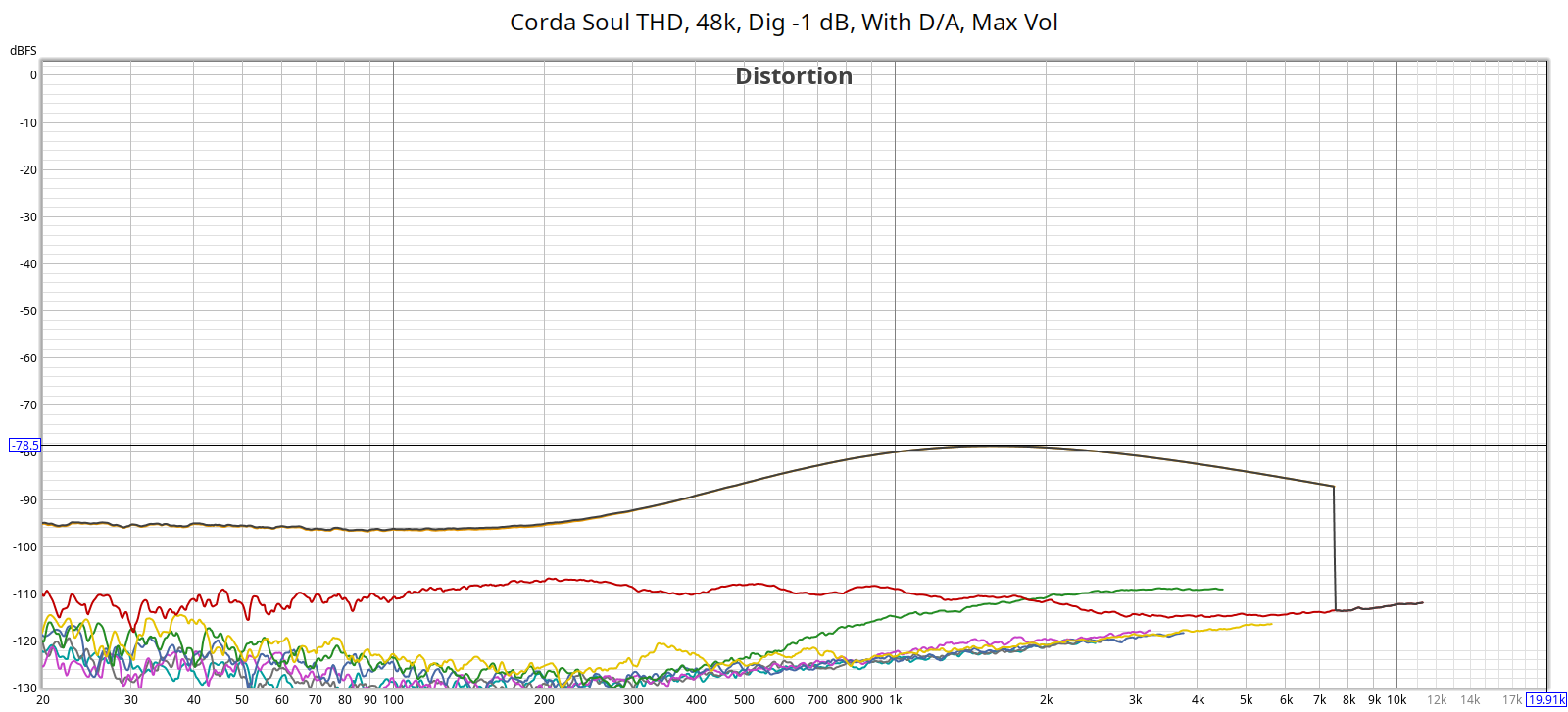 We see an unusual hump peaking at -78.5 dB between 1 and 2 kHz. That is db FS (full scale), which is about -70 dB dBr (relative to the signal). This is surprisingly high distortion. A closer look shows this is entirely 3rd harmonic (orange superimposed on the black) and it peaks between 1 and 2 kHz. This odd harmonic distortion is sometimes seen in balanced (differentially signalled) systems, which tend to squash even harmonic distortion.
What would cause this distortion hump? The WM8741 chip is rated at -100 dB THD, and the Soul should have a reference implementation. I measured this by recording the Soul’s analog output on my Tascam DA3000 recorder, so this includes distortion from its analog stage and A/D converters (rated at -90 dB). But this distortion is higher than that. I know from experience that DACs often have distortion that varies with level (more detail on this from Archimago), especially as digital input approaches full scale, so I measured the same sweep at -6 dB:
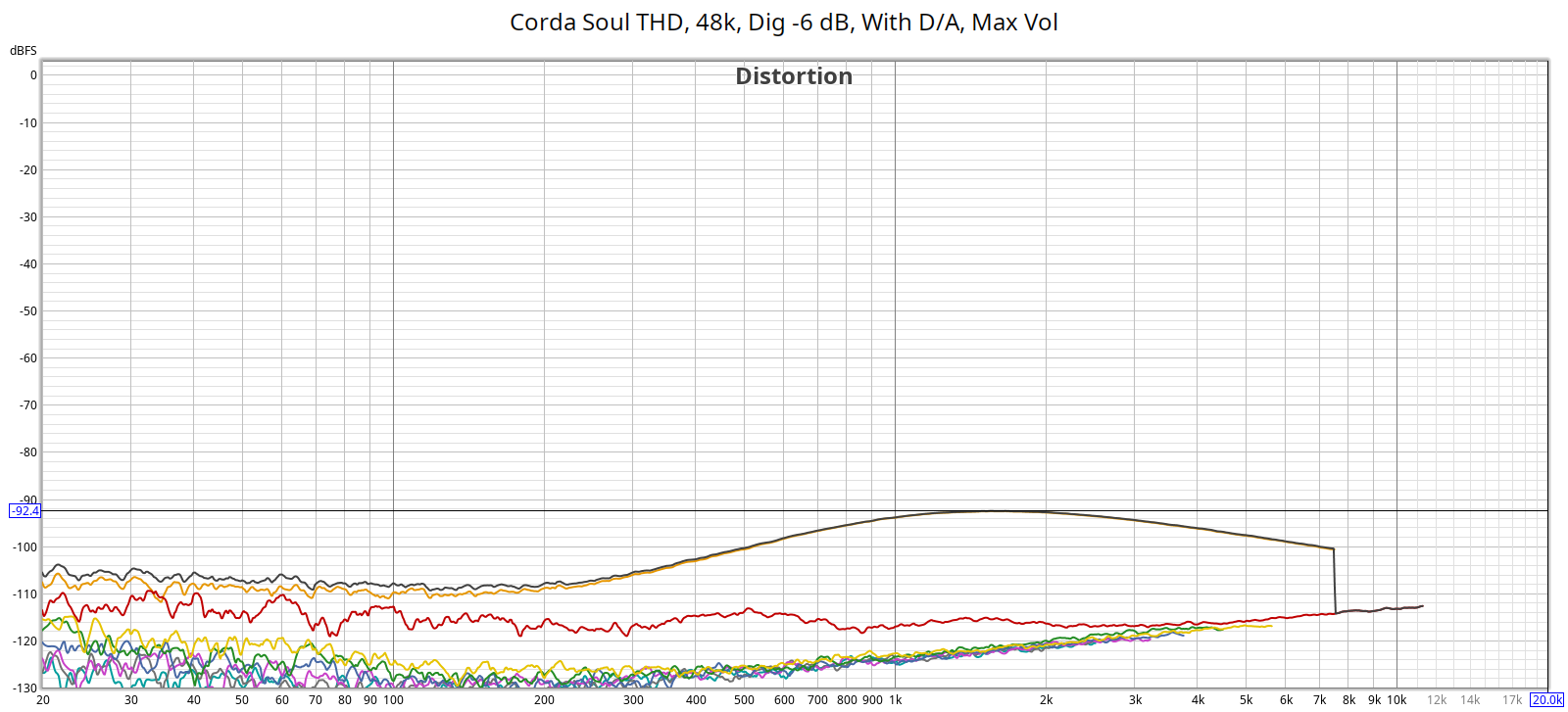 Here the distortion dropped to -92.4 dB, or about 14 dB lower. I also measured it at -12 dB:
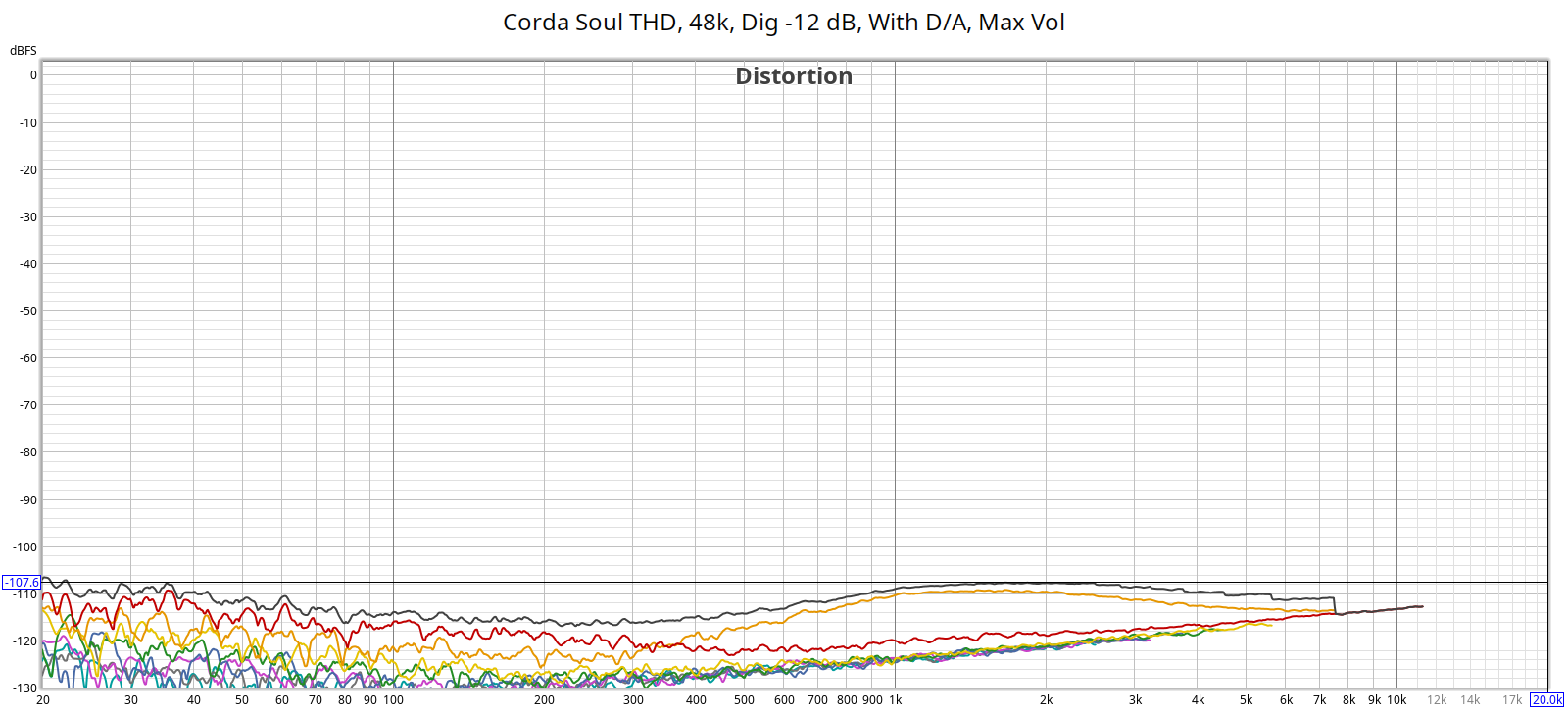 Here distortion drops to -107.6 dB (about -100 dBr), which matches the specification of the WM8741 DAC chip.
I tested distortion every 3 dB from full scale to -40 dB. At -12 dB the distortion falls into the base level noise & distortion of the Tascam recorder I used to measure it. At these digital input levels (-12 dB and lower) the Soul’s distortion is too low for me to measure, given my limited equipment.
Here are the THD versus Level graphs that I measured. First, THD relative to the signal level:
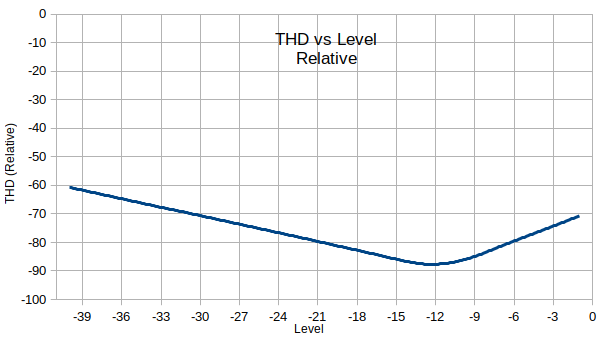
The above graph makes it difficult to see how my measuring device limits this, so here is the same graph shown in absolute terms. This shows how distortion sinks into the noise+THD of the recorder I used to measure it. The slope is about 2:1 – starting at full scale, every 1 dB reduction in signal level gives a 2 dB reduction (improvement) in THD.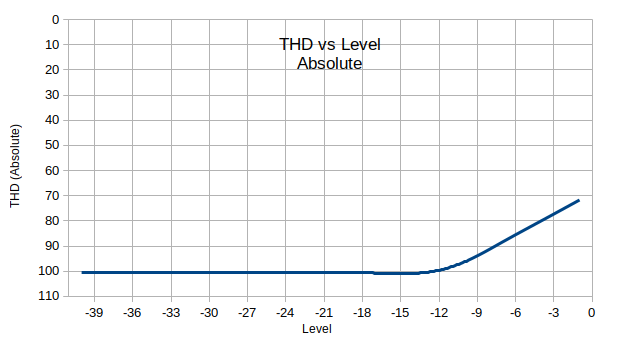
In summary: Noise below -90 dB should be inaudible, and due to psychoacoustic masking, distortion below -80 dB should be inaudible.
Note that this unusual distortion profile is the same at all sample rates (44k to 192k) and digital inputs (coax, toslink and USB).
Perspective: Multitone
We don’t actually listen to pure tones or sweeps, so another perspective on distortion involves multi-tone signals having harmonic spacing that resembles music. I used REW to create a multi-tone signal having 3 frequencies per octave from 20 Hz to 20 kHz, spaced geometrically (constant ratios), for a total of 31 tones.
One aspect of multiple tones is that the signal is the sum of all the tones, so the overall signal level is higher than any of the individual tones. For the signal I used, the overall level is at -1 dB (near full scale) while each individual tone is about -24.7 dB.
A multitone signal like this may show worse distortion, as each of the many tones has its own harmonic series, and intermodulation between them creates even more spurious tones. Alternately, it might have less distortion because the tones that make up the signal must be attenuated to a lower level so their sum doesn’t exceed full scale. DACs sometimes have higher distortion near full scale, achieving their cleanest output around -3 to -12 dB.
Because this test can go either way, it gives additional insight to the DAC’s performance. One could say that DACs that perform worse on multitone are optimized for test tones, and DACs that perform better on multitone are optimized for music. Though of course, some DACs might perform well with both.
Here’s the signal in its pure mathematical form. I played this through the Soul and recorded the SPDIF output on the Tascam – this is pure digital with no D/A or A/D conversion. By “pure” I mean the imperfections in this graph are due to dither and the resolution of the Fourier Transformation used to analyze it.
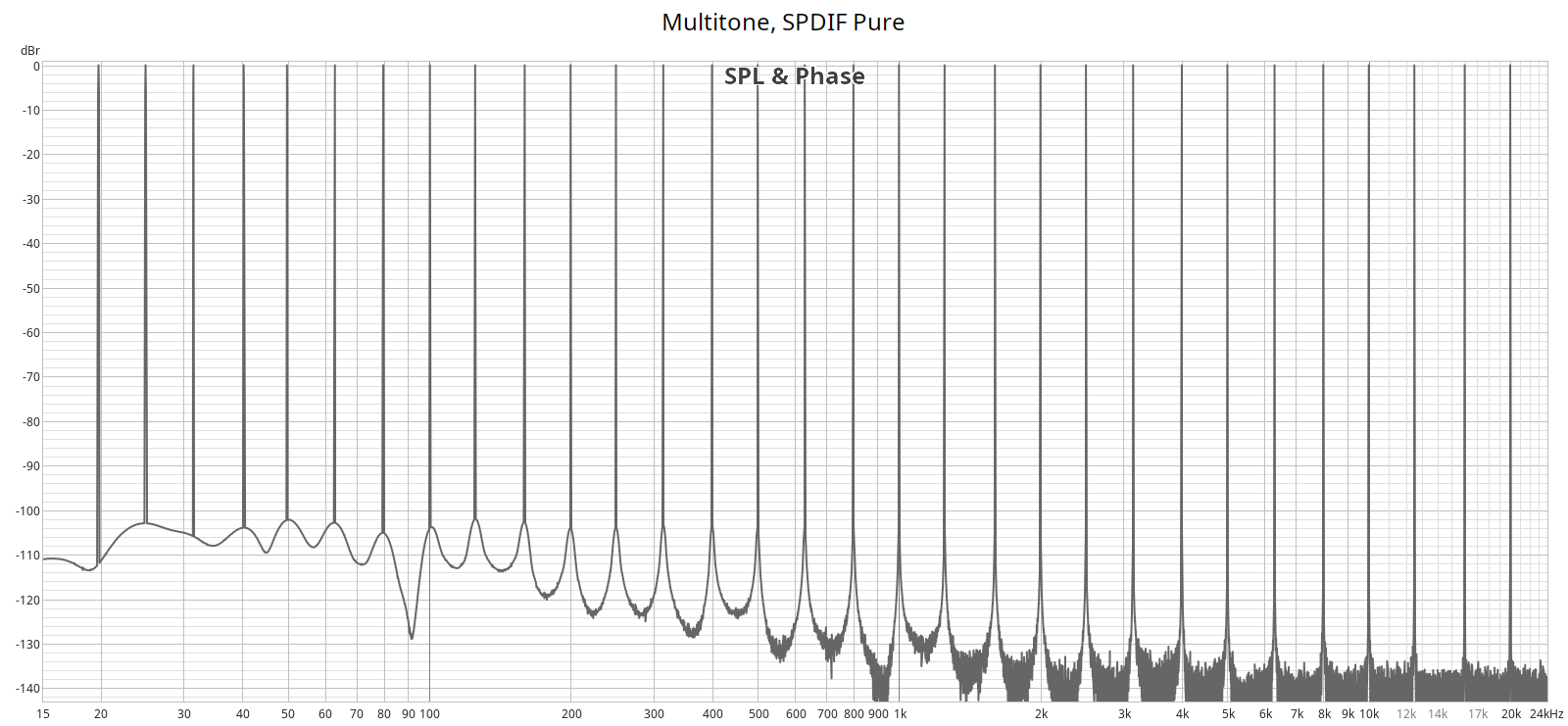
In the following graphs, distortion and noise appear as small spikes or “grass” between the tones. Here’s that same signal played through the Soul’s DA converter and recorded on the Tascam:
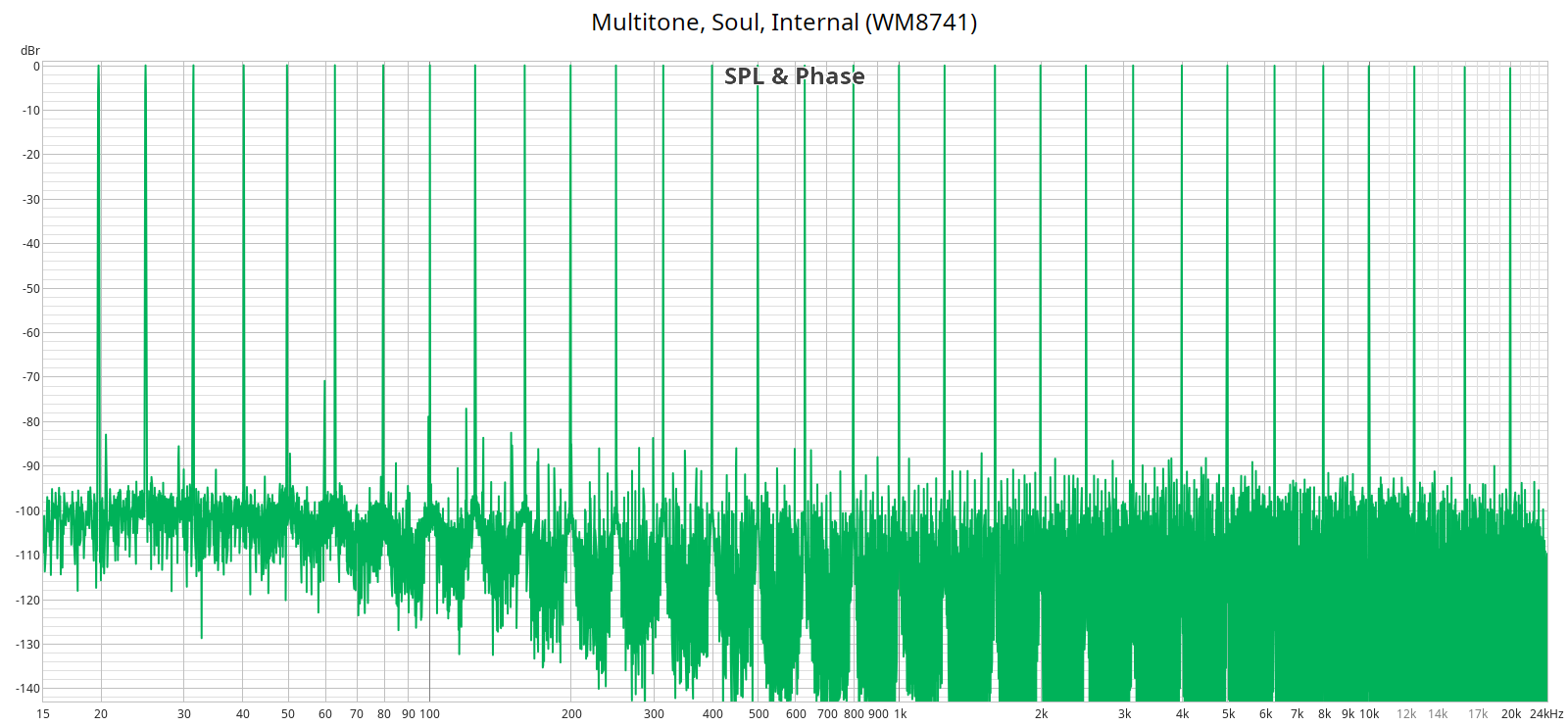
The tips of the “grass” are around -90 dB dBr, which means dB relative to the tones. The tones are at -24.7 dBFS (dB full scale), so the vertical axis 0 dB in this graph is -24.7 dBFS, which means the tips of the grass are at -114.7 dBFS. If we sum the “grass”, they’d total about 30 dB louder, or -85 dBFS. With the multitone signal at -1 dB, that would be -84 dBr. Note that the small spikes at 60, 120 and 180 Hz come from the Tascam DA3000 recorder.
What’s really interesting about this is that the THD vs. level graphs above show distortion at -71 dB for a sine wave at -1 dB. Yet with a multitone at -1 dB, the Soul’s total distortion (both HD and IMD) is about 14 dB lower and its 3rd harmonic distortion hump disappears. The Soul performs better with multitone than it does with a single tone at the same level.
Here’s the multitone at -7 dB (6 dB quieter). Distortion is about the same in the low frequencies, yet now 10 dB lower in the mids and treble where our hearing is most sensitive to it. Note that moving the Soul’s gain switch to the low (-6 dB) position has the same effect, so it applies before DA conversion.
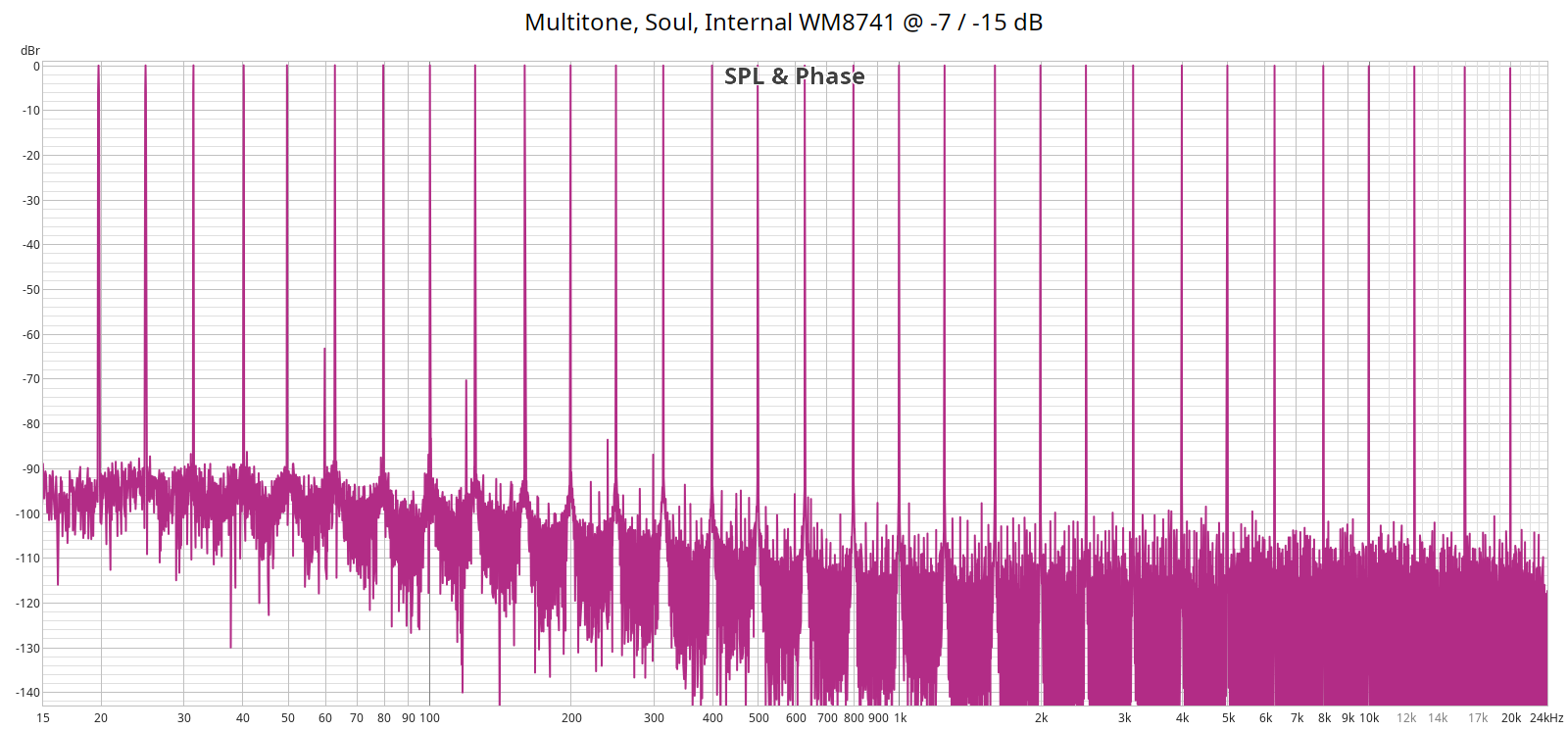
This puts the Soul’s distortion hump into perspective: because music consists of so many frequencies, it’s unlikely to have any single frequency above about -12 dB, and more likely -20 dB or lower even at full scale dynamic peaks, so while Soul’s hump looks bad with individual test tones, it’s cleaner when reproducing music.
To more easily see how distortion drops with digital input level, here’s the Soul’s multitone performance at 3 levels: 0 dB (grey), -6 dB (red) and -12 dB (blue), superimposed.
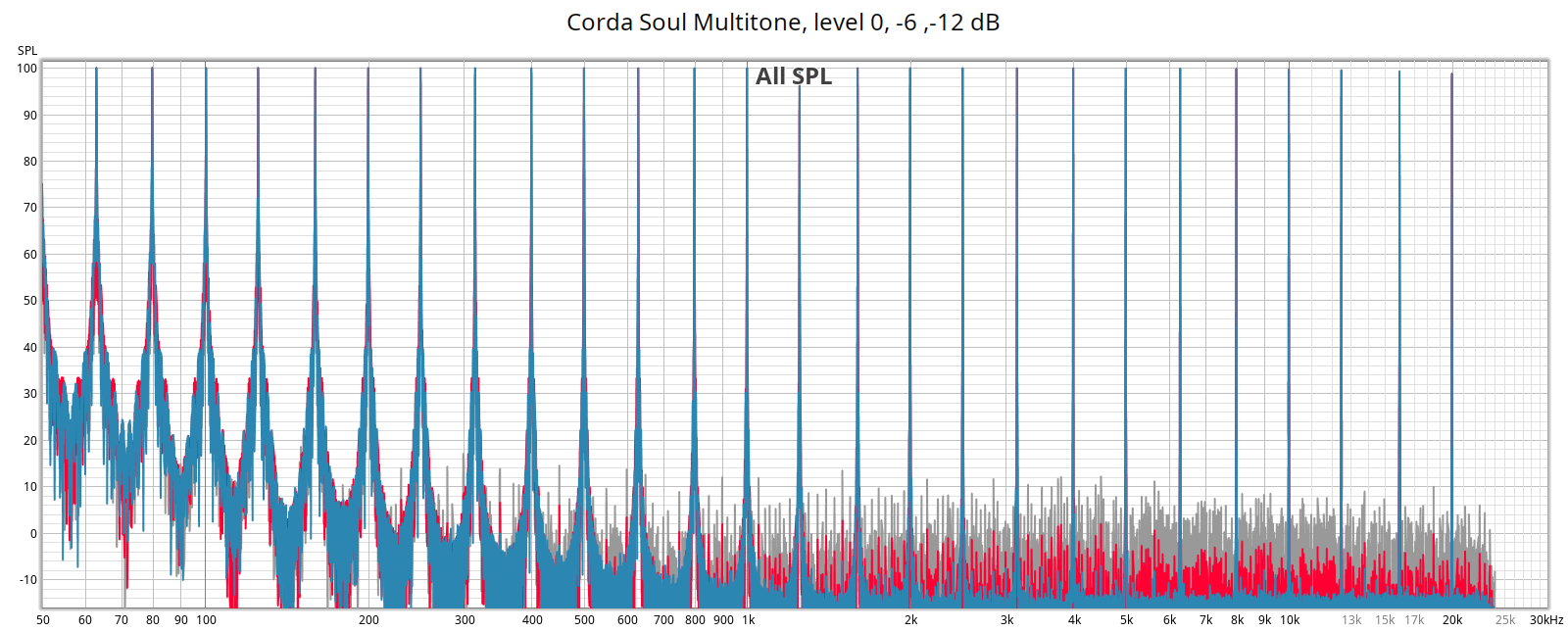
In this graph the lower level inputs (-6 and -12 dB) are shifted upward so the peaks from all three traces are at 100 dB SPL. The tips of the distortion grass are at -90, -100 and -110 dB, respectively.
These THD levels are lower than the specification for the WM8741 DACs that the Soul uses. This multitone distortion performance would have been considered excellent nearly 20 years ago when the 8741 DAC chip first came out.
Another possible contributor to this unusual distortion profile is Meier’s FF (more on this here). It attenuates low frequencies before DA conversion and the amp’s analog gain-feedback loop, in order to reduce overall levels from approaching full scale, and to focus negative feedback on the mids and treble. Yet this only works when low and high frequencies are played simultaneously. With single tones, it makes no difference except to reduce resolution of the low frequencies. Whatever benefits FF provides are only realized with multitone signals. It is a feature that optimizes for music rather than test signals.
Factor: Amplitude vs Frequency
Another factor regarding the relevance of distortion is the relationship between amplitude and frequency. The Soul’s distortion rise at high input levels doesn’t happen at all frequencies. It depends on both input level and frequency. At low frequencies distortion is low even at high input levels, doesn’t start to rise until above 300 Hz and peaks just above 1 kHz. Yet the amplitude of musical signals peaks in the bass and drops as frequency increases. More on that here.
In a musical signal, above whatever bass frequency amplitude peaks (typically below 300 Hz), the amplitude typically drops 6 dB per octave. If we take that highest peak bass frequency as 250 Hz, then 1 kHz is 2 octaves higher and the amplitude has dropped by 12 dB. Thus the level at 1 kHz will be 12 dB below peak, and dropping further for higher frequencies. And that is a worst-case for single tones. As mentioned above, every additional frequency in the musical signal further drops all of their individual levels.
The multi-tone test signals above have all 31 tones at equal amplitude. This overstates the Soul’s distortion when playing music, because in music the high frequency tones would be attenuated, lowering them below the threshold of the Soul’s distortion hump.
The net effect is that the Soul’s unusual distortion hump will never manifest when listening to music. It requires single-tone high frequencies at high input levels, something we only get with test signals.
Deep Dive: Odd Harmonics
The THD that the Soul produces is purely 3rd harmonic alone – all other distortion is below my measurement limits. This in part explains the good multitone performance, because the multitone combines a single harmonic for each frequency instead of a spray of them. What 3rd harmonic distortion (or more generally, odd harmonics) does to a sin wave, is it flattens the peaks & troughs. Here is an exaggerated example showing the effect of 10% (-20 dB) of 3rd harmonic.
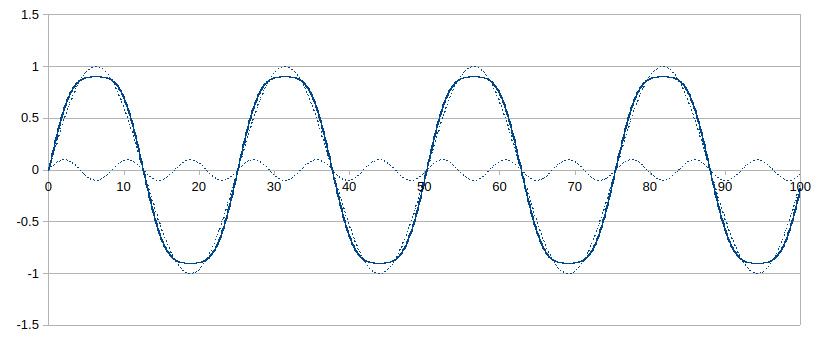
The big dotted wave is the original signal, the small dotted wave is the 3rd harmonic, and the big solid wave is their sum, which shows how the 3rd harmonic changes the waveform. Looking at the two waves, you can see that the 3rd harmonic reverses each of the primary wave’s peaks, squashing them. This diagram is grossly exaggerated. The Soul only adds about -70 dB worst case, and -100 dB typical case, which is about 10,000 times less than the 10% shown above. The effect is too small to see (or hear) and must be exaggerated to see what’s happening.
This peak-squashing only happens only at high digital signal levels, so one possible reason is that the DAC chip isn’t “strong” enough to fully reproduce dynamic peaks. Put differently, it looks like soft clipping. The WM8741 chip is a voltage-output DAC – unlike many modern DACs which are current output and rely on external circuitry to convert current to voltage. When the digital signal gets loud, the 8741 must produce higher analog voltages, which draws more power. If the DAC’s voltage supply sags on peak demand, or the load it’s driving is too low impedance, that is the kind of distortion we’d expect to see: soft clipping which consists of odd harmonics. Another possible cause is parasitic (or designed-in) capacitance, which can cause this kind of time-based non-linearity. This seems plausible because capacitance is frequency-specific, and the Soul’s distortion profile is also (it doesn’t affect low frequencies).
I did measure the Soul with its power supply ground jumper removed, which puts a resistor in the ground path to eliminate ground loop hum. I also tested all digital inputs: coax, toslink and USB. None of these affected it.
Bypassing the DAC
I speculate that the distortion comes from DA conversion… is that actually the case?
To find out, I played test signals through the Soul, bypassing its DAC. This is possible due to a unique feature of the Soul. It has an external DAC loop similar to the tape loop that preamps used to have. This is a switch on the front panel to listen to its analog input – but this switch is separate from the digital input selector and does not disable its digital processing. It still receives and processes the digital input, and sends it out via toslink SPDIF. You can send the Soul’s digital output to an external DAC, and connect that DAC’s analog output to the Soul’s analog input. Of course, the external DAC must have balanced XLR output.
Like this:
(Digital Source)
    --d--> (Soul for DSP)
    --d--> (external DAC)
    --a--> (Soul for volume control)
    --a--> (headphones or line out)
In this mode, the Soul becomes a DSP processor and analog balanced preamp. DAC is handled externally. Why? Future proofing. DSP is purely digital which at 32-bit precision is near mathematically perfect, so it’s not going to improve over time. Analog preamp technology fully peaked and optimized years ago so that’s not improving either. But DACs are constantly evolving, so the Soul enables you to use an external DAC while keeping the rest of the unit.
Here’s the multitone played through the Soul, but using its external DAC bypass with the Topping E70 doing the D-A conversion (and the Tascam DA3000 performing A-D conversion of the final analog output, as before):
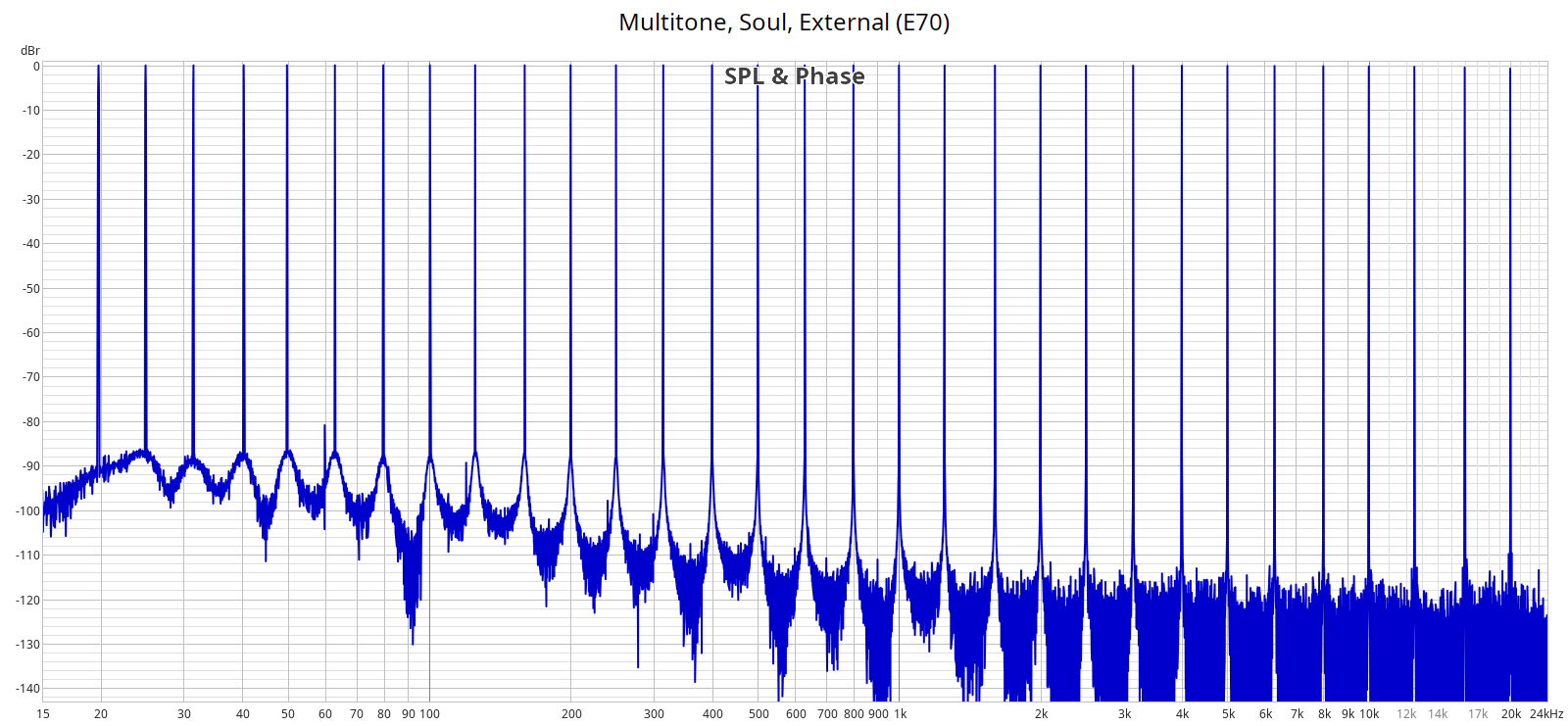
This is cleaner than the Soul’s DAC. More precisely, the E70 at full scale is comparable to the Soul at -12 dB (see below). The E70 is a state-of-the-art DAC that has impressively low distortion both with single tones and multitone. Since these signals were analog outputs captured and digitized by the Tascam DA3000, it shows that the Tascam DA3000 performs significantly better than its specification (though it still adds small spikes at 60 & 120 Hz due to imperfect power regulation), and since this signal passed through the Soul’s analog stage, it shows that it’s impressively free of noise and distortion.
Using a SOTA external DAC like the E70, the distortion hump entirely disappears and overall distortion is so low I can’t measure it with the Tascam recorder.
Comparisons: Distortion, Noise and Level
I wanted to measure at lower output levels because it better matches how we actually listen. We don’t listen to music that is constantly at max digital level (unless you listen to modern pop music that is crushed with dynamic compression, but then high quality audio equipment would be a waste of money, you would have crappy equipment and no musical taste, and wouldn’t be reading this). And we don’t listen with the volume knob turned up to max, but more typically around half way.
I also wanted to make direct comparisons between the Topping E70 and the Soul because the E70 is a modern DAC with excellent measurements. It is the best DAC I’ve ever measured, and among the best that Amir at ASR has measured. As a modern SOTA DAC, it makes a useful benchmark and comparison with the Soul.
As above, I made the following graphs by playing digital test signals into the Soul and recording its analog output on the Tascam DA3000. There are 2 key differences:
- Which DAC I use: the Soul’s built-in WM8741s, or the E70’s ESS9028 Pros
- Whether I control the volume with the Soul, or with the E70 (Soul volume at max)
Generally, the level of noise and distortion varies with two factors that affect its loudness:
- The digital signal level (dB relative to full scale)
- This tends to affect both noise and distortion
- Lower digital levels tend to have lower distortion and higher noise
- Attenuation from the volume setting
- This tends to affect noise but not distortion
- Lower output levels tend to have higher noise
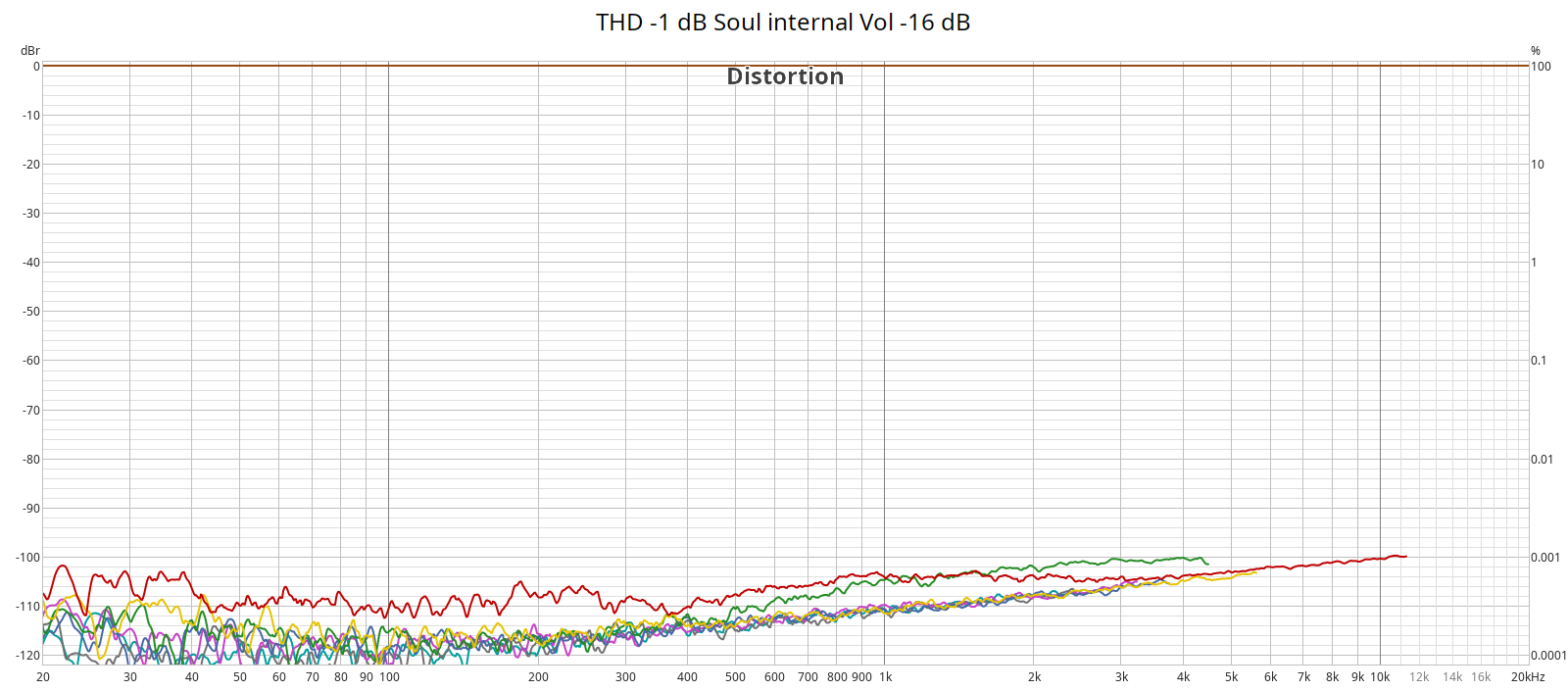
First, let’s look at the distortion frequency sweep at -1 dB digital with volume turned down to -16 dB. This checks overall noise level.
Using the Soul’s internal DACs, the overall noise & distortion peaks between -100 to -108 dB depending on frequency.
Using the E70 DAC and volume control, the overall noise & distortion varies from -90 to -100 dB.
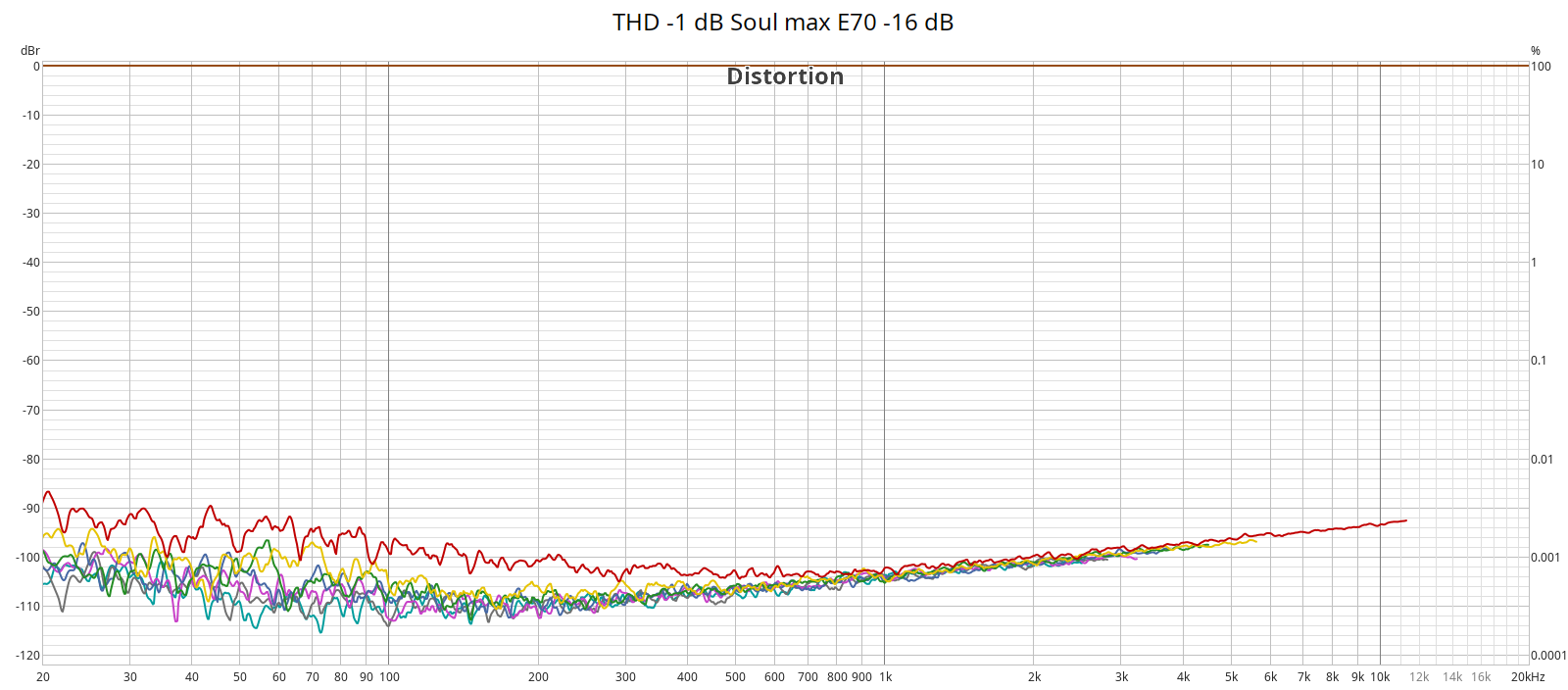
The E70 is no slouch but the Soul is about 10 dB quieter. This comes as no surprise, due to the unique way its volume control works, mentioned in my review of the Soul. It’s interesting to measure and quantify the impact of this engineering feature.
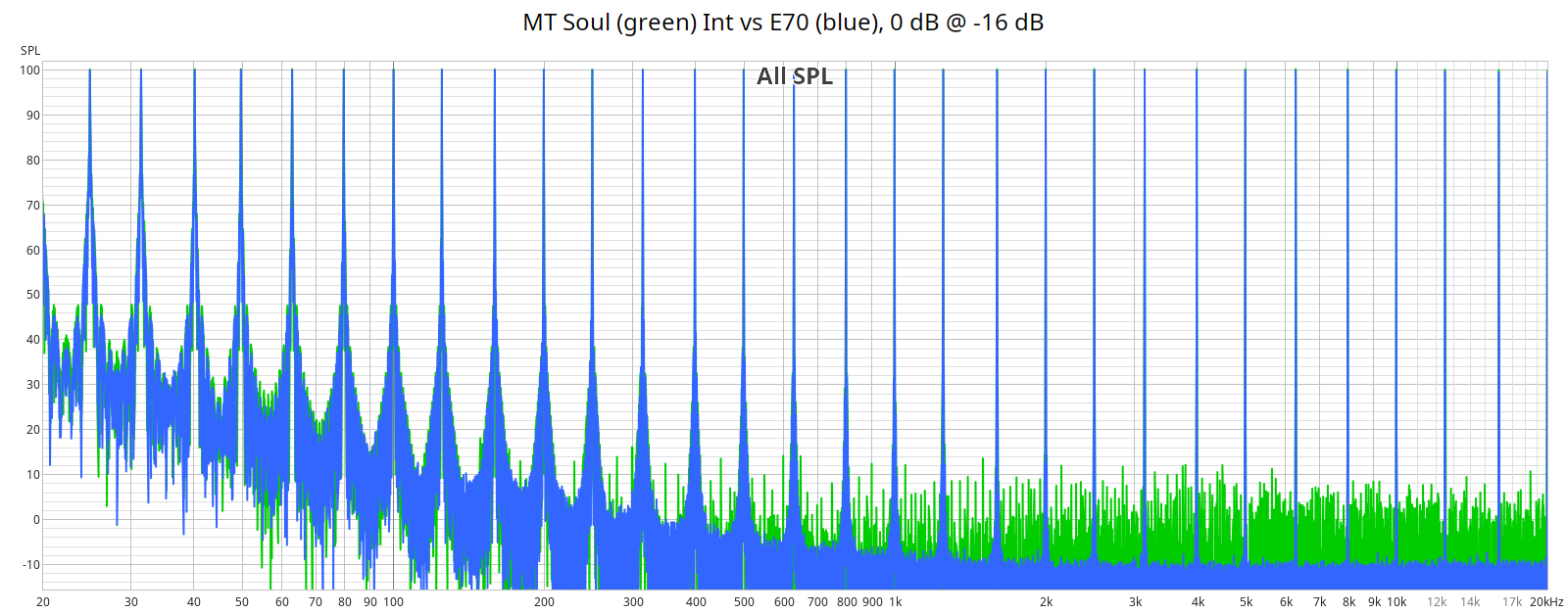
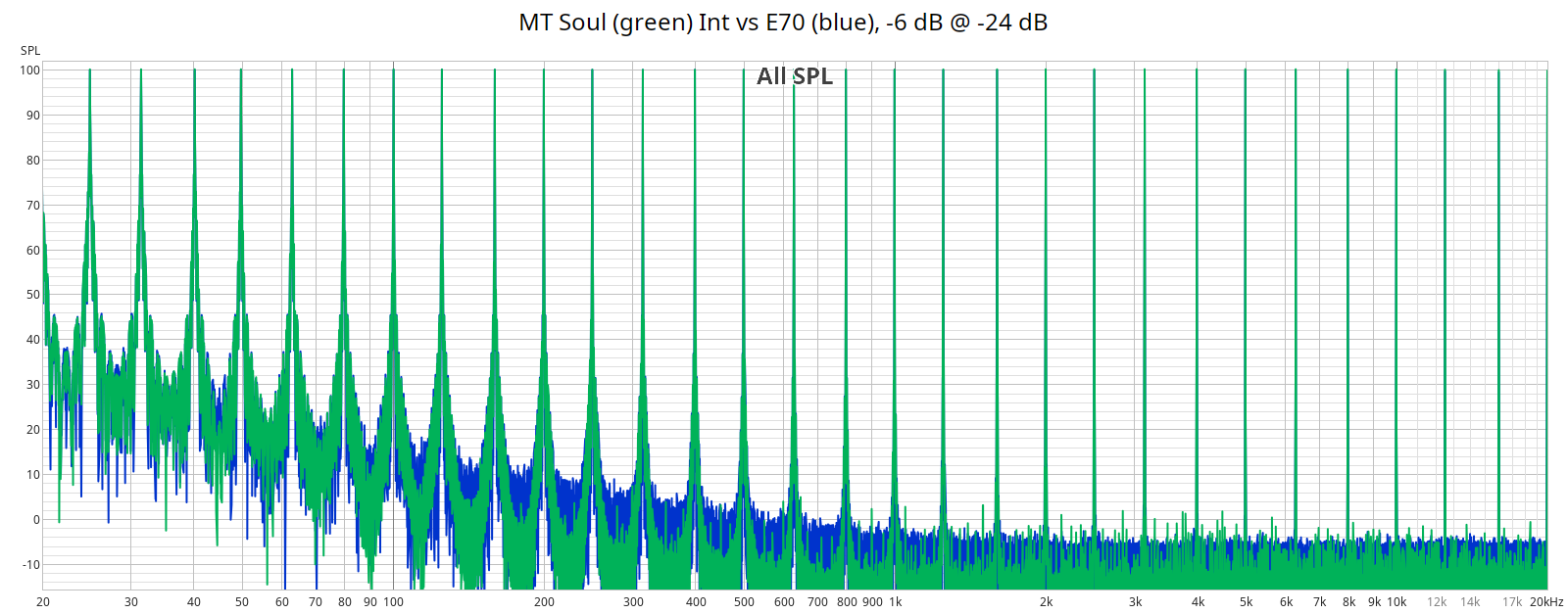
Here’s the comparison for multi-tone at 2 digital input levels: 0 dB and -6 dB, with volume at -16 and -24 dB respectively. The Soul is green and the E70 is blue.
Here is the 0 dB multitone played at -16 dB. Same as above, the tips of the Soul’s “grass” reach around -90 dB while the E70 is about 12 dB lower.
The situation changes when we reduce the levels. The -6 dB multitone played at -24 dB brings near equality as the Soul is now just a tad better than the E70.
Summary
Overall, the E70 is the more consistent performer. Its distortion is independent of level and its SNR drops linearly with level. The Soul is more complex and harder to characterize. I hesitate to say it’s optimized for music listening because we hear this a lot and it’s usually an excuse that expensive boutique audio equipment uses for poor engineering and performance. But this dive down the rabbit hole of measuring noise and distortion opened my eyes to the fact that this phrase can actually mean something. The Soul’s distortion performance is not very good when measured by a full scale tone sweep. But we don’t listen to tone sweeps at full volume. With test signals that resemble music at realistic levels, the Soul’s measured performance rivals the best modern DAC that I have seen. This gives the phrase “optimized for music” some objective meaning.
Conclusion
The E70 has exemplary noise performance, but the Soul’s noise is even lower. The Soul’s distortion depends on digital input level, while the E70 does not. With multitone signals that resemble music they are roughly equal at -12 dB; the E70 is better at higher levels and the Soul is better at lower levels. This is somewhat surprising since the Soul uses a pair of WM8741 chips, which are about 10 years older than the ESS9028 Pro that the E70 uses. This supports the idea that the implementation of a DAC chip is more important than the chip itself.
Using an external DAC with the Soul is a tradeoff between distortion and noise. The Soul does better with noise than with distortion, yet when listening to music in the real world, both are low enough that even the best SOTA external DAC should make no real improvement.
All that said, there are subtle differences that can be detected with appropriate musical source material. If you are well trained how to listen for them. Being a musician helps, as does experience with DBT/ABX testing. Also you need excellent equipment in a superbly quiet listening environment. I listen mostly to small ensemble music and found the Soul and E70 essential indistinguishable. I first noticed a difference when listening to large ensemble symphonic music with high dynamic range, during crescendos. That difference was so subtle I could only hear it on the Magnepans; it was undetectable with high quality headphones. This prompted me to do some critical listening with high quality rock music recordings (rare, but they do exist, such as some albums from Dream Theater and Pink Floyd, and Steven Wilson remixes). This, as well as the measurements above, confirmed the difference, though it remains subtle.